

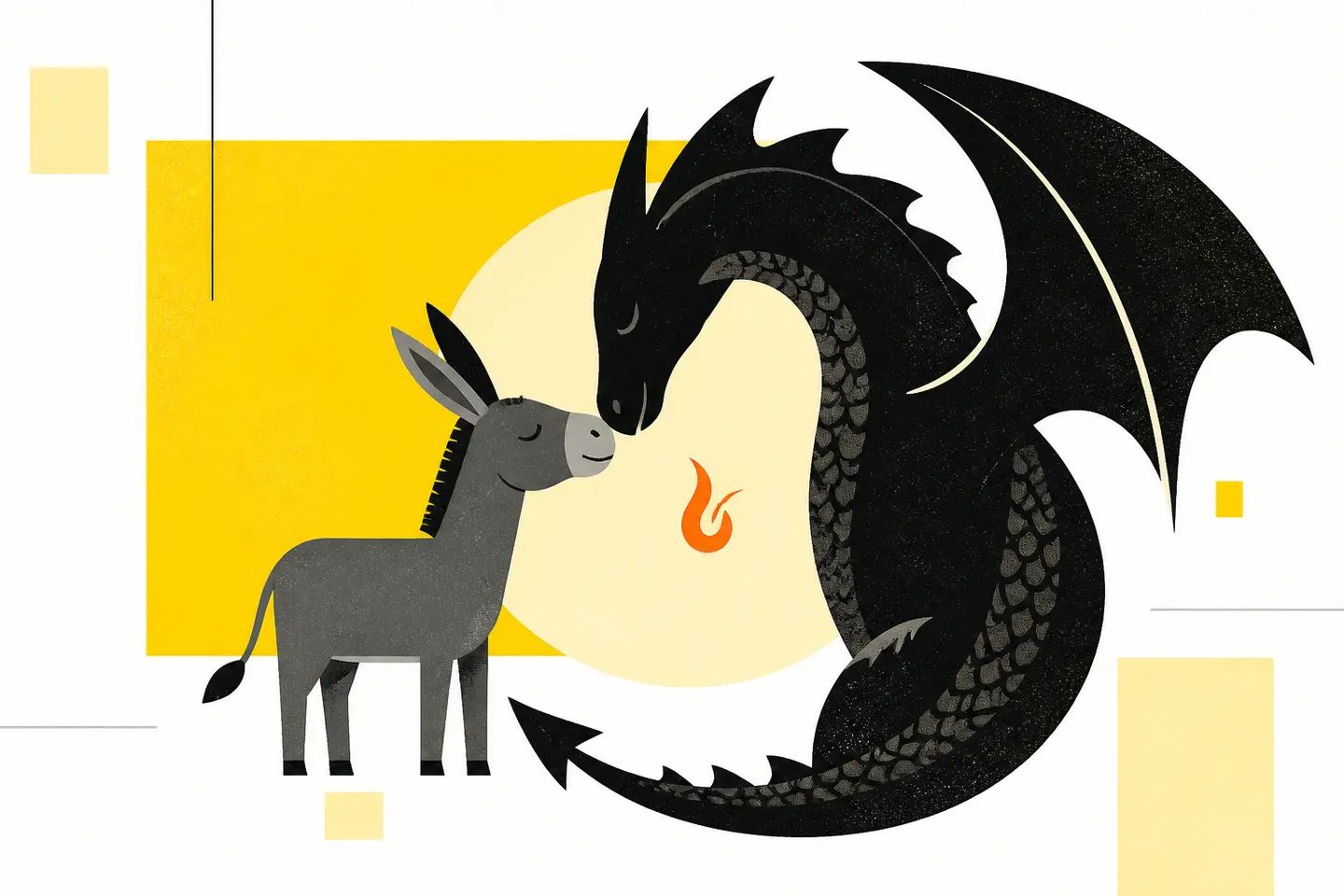
Donkey and Dragon begin as frightened intruder and castle guardian, but their encounter develops into one of the story’s most unusual partnerships. What starts as a comic escape tactic becomes affection, practical loyalty and family life. Their relationship matters because it changes Dragon from an obstacle into a character with choices, while giving Donkey a role beyond being Shrek’s talkative companion.
How Donkey and Dragon meet
Donkey enters Dragon’s Keep with Shrek during the rescue of Princess Fiona. The pair expect to face a dangerous guard, and Dragon initially behaves exactly as that role demands: she separates Donkey from Shrek, corners him and appears ready to eat him. Donkey has neither Shrek’s strength nor a conventional hero’s plan, so he relies on the trait that usually gets him into trouble. He talks.
His compliments are first presented as a survival tactic. He notices Dragon’s response and continues, praising her teeth and appearance rather than treating her only as a monster. The scene works because both motives remain visible. Donkey wants to escape, while Dragon is pleased to receive warmth and attention. The talkative donkey defeats no creature and wins no formal contest; he changes the encounter by recognising that the feared guardian has feelings.
The immediate result is still chaotic. Dragon’s affection alarms Donkey, Shrek pulls him away, and the group escapes across the damaged bridge. Yet the meeting establishes more than a single joke. Dragon later returns during Fiona’s wedding, helps stop Farquaad and carries the central characters away. Her decision to assist them shows that she is no longer bound to the function assigned to her at Fiona’s prison tower.
How the relationship develops
The first film moves quickly from pursuit to attraction, so much of the relationship is conveyed through action rather than conversation. Donkey supplies nervous chatter; Dragon communicates through expression, movement and decisive intervention. This imbalance creates the comedy, but it also gives the pairing a recognisable rhythm. He fills silence, while she makes her intentions unmistakable.
Later stories treat the romance as an ongoing relationship rather than resetting the characters after the ending. Donkey refers to difficulties between them and to needing time apart. The detail is brief, but useful: attraction has become a partnership that can include frustration, misunderstanding and reconciliation. Dragon subsequently returns to help the group, and the arrival of their children confirms that the pair have built a family.
An altered timeline later shows why their first meeting matters. When the events surrounding Fiona’s rescue have not happened, Dragon does not recognise Donkey and their shared life does not exist. The device turns a familiar relationship into a consequence of specific choices. Donkey’s decision to speak rather than fight, and Dragon’s decision to respond rather than attack, create everything that follows.
Dragon’s changing role
Dragon is introduced through a familiar fairy-tale function: she guards a princess in an isolated tower and threatens anyone attempting a rescue. A conventional version of the tale would ask the hero to kill or defeat her. Instead, the story lets the supposed monster leave the post, choose her allies and take part in the resolution.
That change does not make Dragon harmless. She retains her size, fire, flight and physical power. What changes is the purpose for which she uses them. At first those abilities enforce Fiona’s confinement; later they protect Donkey and his friends. Her intervention at the wedding is important because it resolves an immediate danger that the others cannot easily overcome. She is not simply transport or scenery but an active participant whose choice alters the outcome.
Her shift also mirrors the treatment of other characters. Shrek is judged by his appearance, Fiona is confined within expectations about princesses, and Donkey is often dismissed because he talks too much. Dragon is likewise introduced as a label before she is treated as an individual. The relationship gives the audience a simple way to see past that label without requiring a speech explaining the theme.
The Dronkeys and family life
Donkey and Dragon’s children combine donkey bodies and faces with dragon wings and tails. Their design turns the parents’ unlikely pairing into an immediately readable visual idea. The children are energetic, affectionate and able to fly, which creates comic disorder whenever the family arrives together.
The Dronkeys also make an important point quietly. No character demands an explanation for what the children are, and their mixed features are not presented as a problem to solve. They belong within a world already populated by ogres, talking animals and transformed royalty. Acceptance is shown through ordinary family behaviour rather than a separate lesson.
- From Donkey: long ears, muzzles, grey colouring and restless energy.
- From Dragon: wings, tails, flight and a strong physical presence despite their small size.
- From both parents: eagerness to join the group and affection expressed with little restraint.
Parenthood extends Donkey’s character without replacing his established personality. He remains impulsive, sociable and closely involved in Shrek’s problems, but he is also a partner and father. Dragon’s appearances similarly connect large rescue scenes with domestic comedy. Their family can arrive as powerful help and, moments later, overwhelm Donkey with excited attention.
Why the pairing is funny
The central joke reverses the expected ending of a hero-versus-dragon encounter. Donkey does not slay the guardian; the guardian becomes interested in him. The humour depends on contrast: his small size against hers, his constant speech against her wordless reactions, and his initial panic against her confidence. Each difference is clear enough to make a scene work before the audience knows where the relationship will lead.
The pairing also fits the films’ wider habit of rearranging familiar stories. Castles, rescues and magical transformations remain recognisable, but characters refuse the roles attached to them. Academic discussion of intertextual gags in Shrek 2 provides a useful framework for noticing how familiar references gain new meaning when placed in an unexpected context. Donkey and Dragon offer a particularly clear example because the old conflict is not merely mocked; it produces a new relationship.
The comedy lasts because the characters do not become interchangeable. Donkey remains verbose and easily flustered. Dragon remains direct, physically imposing and largely non-verbal. Affection brings them together without erasing the contrast that made their first scene entertaining.
What to watch for across the story
A focused viewing makes the relationship easier to follow because many of its developments happen in short scenes. Start with Donkey’s change in approach during the castle encounter. His praise begins in fear, but his willingness to engage Dragon as a person creates the opening for genuine attachment. Then note Dragon’s independent return at the wedding: she chooses to act after the rescue party has already left her behind.
In later appearances, look for brief signs of an established life rather than expecting a separate romance plot. References to disagreement, reunion and parenting do most of the work. The altered timeline provides the clearest contrast, showing a Dragon who has the same abilities but none of the shared history that made her an ally.
- Notice agency: ask when Dragon follows an assigned role and when she makes her own decision.
- Track consequences: connect the first conversation to the wedding rescue, later adventures and the Dronkeys.
- Watch the comic rhythm: Donkey’s words and Dragon’s reactions often tell two sides of the same scene.
- Compare expectations: consider how the encounter differs from a traditional rescue in which a dragon is only an enemy.
Seen in sequence, Donkey and Dragon’s story is compact but coherent. A frightened attempt at flattery opens the possibility of trust; trust leads to chosen loyalty; and that loyalty grows into a family. The pairing remains memorable because it serves the plot, supports the story’s treatment of appearances and expectations, and keeps its comic contrast intact.