

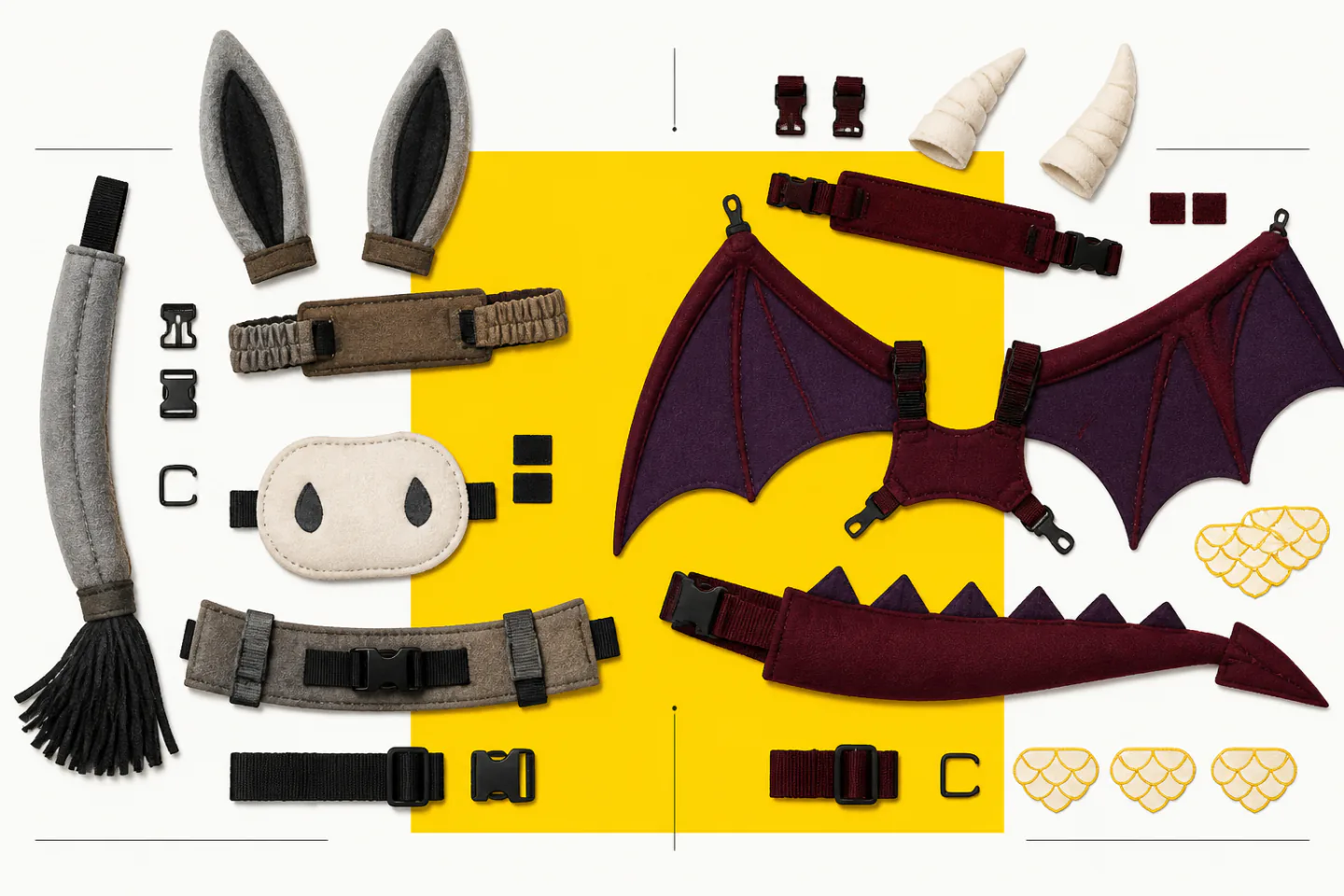
A donkey and dragon costume works well for two people because the characters have contrasting shapes but can share a clear colour palette. The donkey needs long ears, a short mane and a tasselled tail. The dragon needs wings, horns or soft back spikes and a pointed tail. Those features are enough to make the pairing readable without full masks or bulky mascot suits.
Plan both costumes together before buying or cutting anything. Decide where they will be worn, how long the wearers must remain in them and whether they need to sit, use stairs or travel by car. Comfort, visibility and secure attachments matter more than intricate decoration.
Choose a practical shared design
Start with ordinary clothes in suitable base colours. Medium grey, charcoal or brown works for the donkey. Burgundy, deep purple, dark green or rust works for the dragon. Repeat one accent colour across both outfits: cream inner ears can match wing membranes, or black hooves can match dragon claws. This small repetition makes separate homemade pieces look intentional.
Keep the silhouettes different. Give the donkey tall ears and a narrow tail, then give the dragon a wider shoulder shape through folded wings. If the event is crowded, use a cape with a scalloped edge instead of projecting wings. It still suggests a dragon when opened for photographs but rests close to the body while walking.
DIY donkey and dragon costume ideas can help with shapes and colour planning. Treat any picture as a starting point, then adapt it to the wearer, venue and materials available.
Build the donkey costume
A grey hooded top and trousers or leggings provide a simple base. Add an oval cream or pale-grey belly panel with removable fabric tape if the garment will be reused. Black gloves and dark, closed shoes suggest hooves without making walking difficult.
For the ears, cut two matching outer shapes from felt and two smaller inner shapes in a lighter colour. Wrap the lower edge of each ear around a fabric-covered headband and stitch it closed. A small piece of flexible craft foam between the felt layers can keep an ear upright. Round every corner and avoid exposed wire.
Make the mane from short loops of yarn or a strip of soft faux fur attached to the hood. Keep it flat at the neckline so it cannot catch on a coat. A tail can be a lightly stuffed fabric tube with a yarn tassel. Fix it at the natural waist with a sewn tab, belt loop or hook-and-loop fastening. It should end well above the floor when the wearer bends or climbs stairs.
Full face paint is unnecessary. A small dark nose and a light muzzle shape leave the eyes and mouth clear. Test face products on a small patch of skin in advance, and skip them if the wearer finds them uncomfortable.
Build the dragon costume
Use a plain top, dress or jumpsuit as the base. Add a lighter belly panel or rows of overlapping felt semicircles to suggest scales. Sewn or removable details are more dependable than loose glitter, sequins or hard plastic gems, especially around children and busy indoor spaces.
Wings need to be light and easy to remove. Cut a fabric or thin foam wing shape, reinforce its upper edge with flexible material and attach it to broad elastic shoulder straps. Another option is to sew folded fabric wings to a simple vest. Test the wings over any coat the wearer will use. Straps should sit flat, allow both arms to lift and release without help.
Soft horns can be made from upholstery foam covered with fabric, then stitched to a hood or fabric-covered headband. Back spikes should compress when the wearer leans against a chair. Make the tail from a tapered fabric tube with light stuffing, and attach it at the waistband. A short tail is easier to control and less likely to sweep objects from low tables.
Avoid rigid wing frames, pointed horns and any headpiece that shifts towards the eyes. If the dragon needs more detail, use contrasting cuffs, a scale-textured pouch or a small fabric crest rather than adding weight to the head and back.
Check fit, comfort and movement
Fit every accessory over the complete outfit, including outerwear. Headbands should stay in place without pressing behind the ears. Shoulder straps should not rub the neck or restrict breathing. Fasteners must hold during normal movement but release quickly if a wing or tail catches.
Ask each wearer to walk, turn, sit, crouch, reach overhead and use a flight of stairs. Then check clearances around ears, wings and tails. The wearer should be able to see forwards and to both sides. Closed shoes with secure soles are safer than fabric foot coverings that extend beneath the shoe.
Children need proportionally smaller accessories, not adult pieces tightened to fit. Keep their tails short and wings close to the shoulders. An adult should inspect all attachments and watch the child practise moving before the event.
Pet costumes require a different standard. Use only a light, purpose-shaped cape, collar decoration or harness attachment, and supervise continuously. Nothing should cover the animal's eyes, ears, nose, mouth or legs. Remove the accessory at once if the animal freezes, pants, scratches at it or tries to chew it.
Prepare for the venue and weather
Indoors, wide wings and long tails can catch on doors, chairs and other people. Make large pieces detachable or foldable, and practise removing them. A companion can help a wearer in a full head covering, but the safer choice is usually an open headband or hood. General Mascot costume safety guidance is useful when checking sightlines, balance and movement.
For warm conditions, choose breathable base layers and schedule breaks out of the costume. Foam, fleece and synthetic fur retain heat, especially around the head and torso. Keep water accessible and watch for dizziness, headache or unusual fatigue. More detailed heat and comfort practices for mascot costumes can inform the final check.
In cool weather, add thin layers beneath the costume rather than a bulky coat that changes the fit. For rain, avoid absorbent tails and wings that become heavy. After dark, place reflective trim or a small light on the wearer without covering the costume's main features.
Pack a compact repair kit containing spare elastic, matching thread, fabric tape and covered safety pins. Use pins only for an emergency repair, with the clasp secured away from skin. Also carry a plain bag for any accessory that becomes uncomfortable.
Coordinate props and photographs
Props should be light, blunt and easy to put down. A fabric satchel or foam vegetable suits the donkey, while a soft egg-shaped prop or scale-pattern pouch suits the dragon. Avoid long staffs and trailing ropes in crowds. Give both costumes footwear of similar visual weight, such as dark boots or plain trainers, so one outfit does not appear much more finished than the other.
Before taking photographs, check that ears are upright, wing straps are hidden and tails are not trapped under clothing. Let the dragon open the wings only when there is clear space. A three-quarter angle usually shows the donkey's ears and the dragon's wing shape without requiring exaggerated poses.
Clean, store and reuse the pieces
Read garment care labels before cleaning. Wash removable fabric parts separately when possible. Wipe foam ears, horns and wings with a lightly damp cloth and mild soap, keeping water away from glued seams. Spot-clean mixed-material pieces instead of soaking them. These cosplay costume storage and maintenance practices give a useful overview for delicate components.
Allow every part to dry fully in a shaded, ventilated place. Damp foam and dense fabric can develop odours in storage. Keep garments on a wide hanger or folded loosely in a breathable container. Support wings and horns so they are not crushed, and store small fasteners in a labelled pouch.
Inspect the costumes before the next use. Replace stretched elastic, loose stitching and peeling adhesive rather than relying on a last-minute repair. Photographing the assembled outfits can make it easier to reconnect each piece correctly.
Designing the pair as separate modules makes reuse straightforward. Donkey ears and a grey hood can become a farm-animal costume. Dragon wings, cuffs and a tail can support another fantasy character. Neutral base clothes return to ordinary use, while removable panels, horns and manes stay ready for a future event.
Final fitting checklist
- Confirm that both wearers can see, breathe, walk, sit and use stairs.
- Shorten anything that touches the floor or swings into other people.
- Cover hard edges and remove exposed wire, loose gems and shedding glitter.
- Test every strap and fastening over the clothes worn at the event.
- Make wings, masks and warm headpieces quick to remove.
- Carry water and a safe place to store discarded accessories.